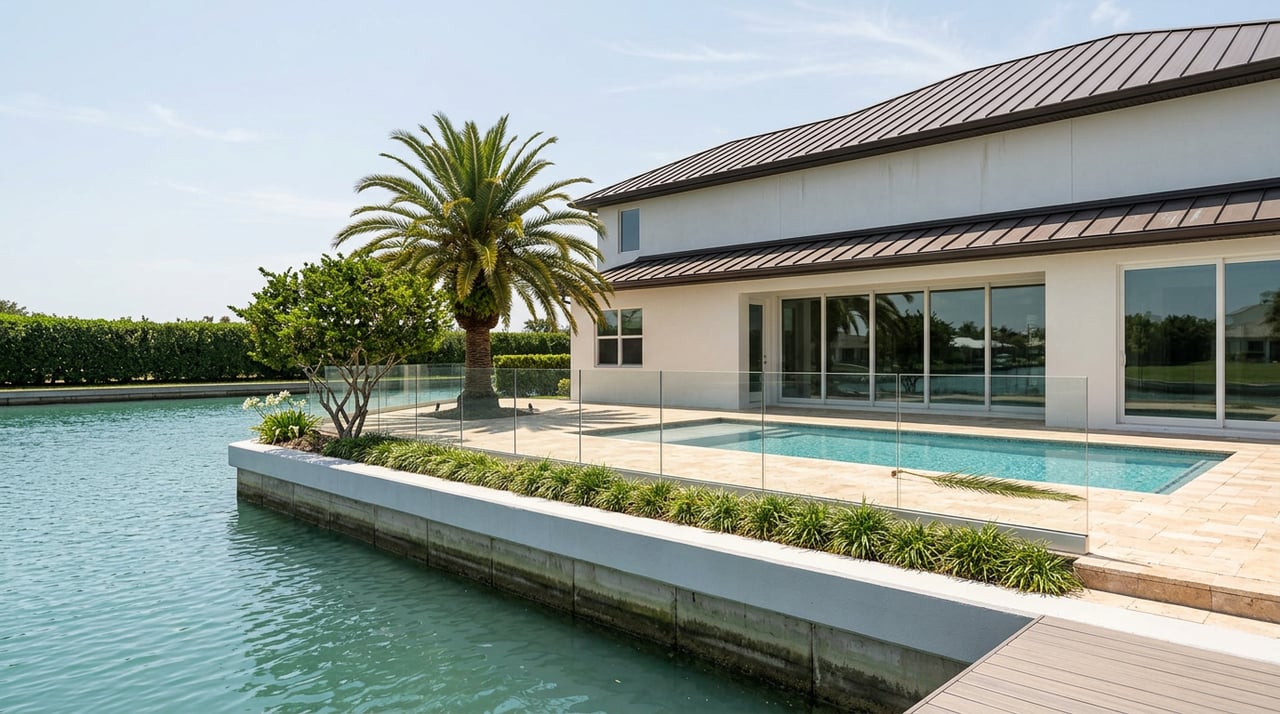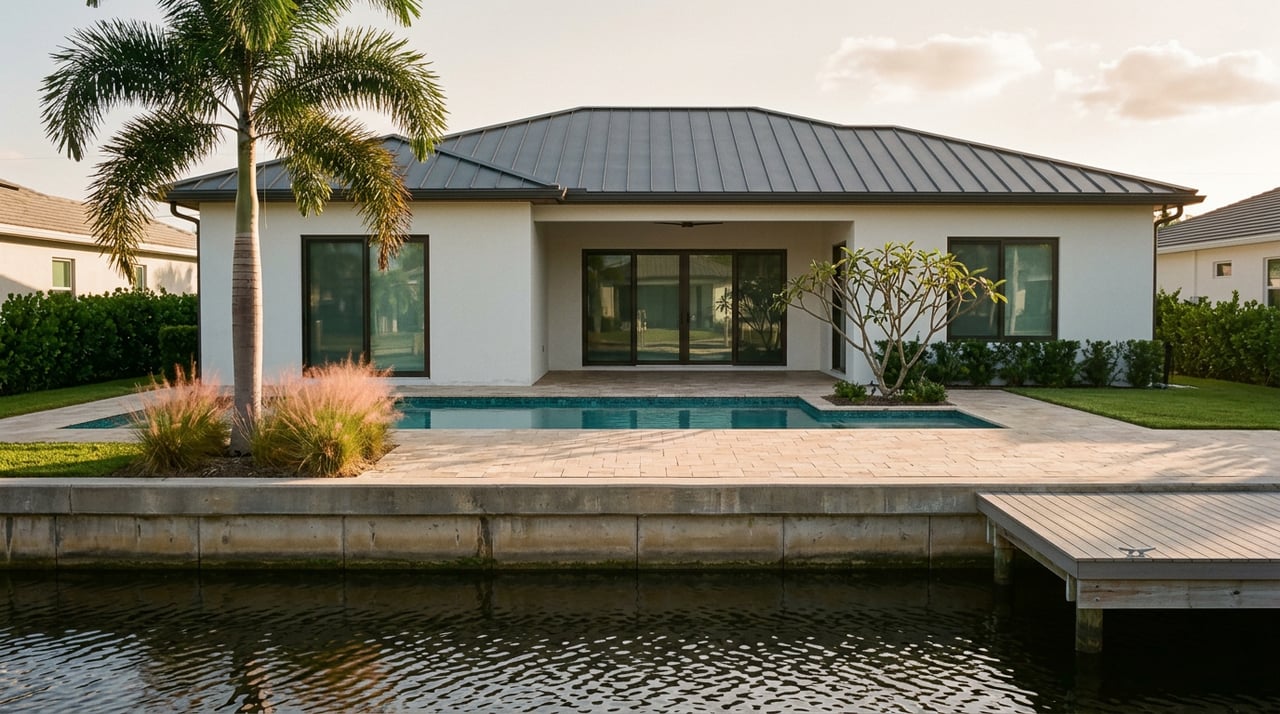
What does the seawall behind your dock actually cost you?
Not the dock. Not the boat lift. The wall itself, the one holding your yard in place against tidal push twice a day, every day, for however many decades it's been down there. If you're touring canal-front homes in Rotonda West, that's the question the listing sheet never answers, and the answer has gotten more expensive since the county's post-hurricane assistance money ran out.
The Bill That Isn't on the Listing
A home's list price reflects square footage, bedrooms, lot size, maybe a recent kitchen. It does not reflect the condition of the seawall standing between that lot and the canal. That structure is a separate, often six-figure question that only surfaces once someone actually looks at it, and in Florida the responsibility for it belongs to the property owner. It's not a city function. It's not something an HOA absorbs unless the wall is part of a shared or community-owned structure. Whoever holds the deed holds the wall.
That distinction matters everywhere in Southwest Florida, but it matters more in a community built the way Rotonda West was built.
Twenty-Six Miles of Reasons This Matters Here
Rotonda West's own community materials put the number at 26 miles of canals, plus ponds and lakes, running through a planned neighborhood that took shape from the 1970s through the 2000s. That's not a handful of waterfront lots tucked along one road. It's a structural feature of the whole community, threading through sections like Pinehurst, Broadmoor, and Oakland Hills, each built in a different decade with a different generation of seawall behind it.
Age spread like that means you can't assume anything about a wall's condition from the neighborhood's reputation or the home's year built. A 1980s section might have a wall that was replaced five years ago. A 2000s section might sit on the original one. The only way to know is to look.
What an Inspector Actually Checks
A seawall doesn't usually fail all at once. It tells you first, if you know where to look:
- Leaning or bowing panels — a sign the wall is losing its fight against pressure or water behind it
- Cracks wider than a quarter inch — an entry point for water and soil movement
- Soil voids or soft ground behind the wall — dirt washing through gaps means the land behind the wall is going hollow
- Rust stains or corroding hardware — metal tie-backs and fasteners weaken with age and salt exposure
- Water pushing through the wall face during normal tides — not storm surge, just a regular high tide
None of these show up in listing photos. Most don't show up on a standard home inspection either, since general home inspectors typically don't climb down to the water line. If you're serious about a canal-front property here, a dedicated marine or seawall inspection is worth the separate cost before you're deep into a contract.
Repair or Replace: The Real Numbers
Once you know a wall has a problem, the next question is whether it needs a patch or a rebuild. The price difference is not small.
Scope of work | Typical cost on a Southwest Florida canal lot |
|---|---|
Targeted repair (sound structure, isolated damage) | roughly $150–$900 per linear foot |
Full replacement, vinyl sheet pile | roughly $300–$650+ per linear foot |
Permit and engineering review fees | an additional $5,000–$20,000 |
A 100-foot wall, a common length on a standard canal lot, can mean anywhere from a $15,000 patch job to a $65,000 or more full rebuild once permitting and engineering are added in. That's a real swing, and it's exactly the kind of number that shows up after an offer has already been accepted, not before.
The Permit Chain Charlotte County Runs You Through
Rotonda West is unincorporated Charlotte County, so any seawall work, repair or new construction, runs through the same county process as the rest of the region. A few specifics worth knowing before you're the one signing the application:
- Projects with a contract price over $5,000 require a recorded Notice of Commencement before the first inspection can even be scheduled.
- Drawings and plans must be signed and sealed by a licensed engineer, not just sketched by a contractor.
- Depending on the project's footprint, the Florida Department of Environmental Protection or the U.S. Army Corps of Engineers may need to sign off separately if the work touches state or federal jurisdictional waters.
- A permit is void if construction doesn't start within 180 days, and an owner-builder who pulls a permit personally can't sell or rent the property within one year of completing that work.
That last rule matters more than it looks like on paper. If a seller pulled an owner-builder permit to patch a wall right before listing, that one-year restriction is now part of the property's timeline, and it's the kind of detail a buyer's agent should be asking about directly rather than assuming away.
The Safety Net That's Already Gone
Here's the part that changes the calculation for anyone buying or selling here right now, and it's a detail easy to miss if your information is more than a year old.
After Hurricane Ian and Hurricane Nicole, Charlotte County ran a Seawall Repair Assistance Program that reimbursed homesteaded homeowners for up to 50% of what they'd already spent fixing storm-damaged walls. Applications closed on May 30, 2025, with remaining funds required to be spent by June 30, 2025. The county's own posting for the program now reads that the listing is no longer available.
That program covered storm damage tied to two specific hurricanes, so it was never a permanent fix for ordinary aging or routine wear. But it did function as a real financial cushion for anyone whose wall took a hit in 2022, and that cushion has been gone for well over a year now. If a seller mentions they're "waiting on county assistance" for wall repairs, or a buyer is assuming some kind of reimbursement might offset a repair estimate, that assumption is out of date. The full cost, on a canal lot with wall problems today, lands on whoever owns the property when the work needs to happen.
What This Changes at the Negotiating Table
There's no standard formula in Florida for how a failing seawall gets handled in a purchase contract. Credits, price reductions, or repair-before-closing agreements all happen, but each one comes down to what buyer and seller actually agree to in that specific deal. Without a county reimbursement program in the background, sellers have less room to argue that help is coming, and buyers have more reason to get a written seawall inspection and an actual contractor quote before writing an offer, not after.
Charlotte County Seawalls, a family-run marine contractor that's been building and repairing walls across this stretch of coast since 1974, works projects that span from Burnt Store Isles up through Sarasota. The busiest calls a contractor like that gets right now are exactly this: buyers and sellers trying to get a real number on a wall before a deal falls apart over one.
A Short FAQ
Does the HOA or the county maintain the seawall in Rotonda West? No. In Florida, seawall maintenance is almost always the individual property owner's responsibility unless the wall is part of a shared or community-owned structure, which is uncommon on a standard residential canal lot.
Can a home inspection catch seawall problems? Not reliably. A general home inspection typically doesn't include a close look at the water line. A separate marine or seawall-specific inspection is the only way to know what's actually happening below the visible edge.
Is there any funding available for seawall repair right now? The county's post-Ian and post-Nicole reimbursement program has closed. As of this writing there's no active county program covering ordinary seawall repair or replacement costs.
How long does a seawall permit take in Charlotte County? Permits are void if construction doesn't start within 180 days of issuance, so timing a repair around a closing date takes some coordination with both the contractor and the county's review schedule.
A canal lot in Rotonda West is still one of the better ways to get real water access without Gulf-front pricing. Just know that the number on the listing and the number waiting at the water's edge are two different conversations. If you're weighing a canal-front purchase or getting ready to sell one, Traci Creighton and the Creighton Reyes Group can walk the property with you, help you line up the right inspection, and make sure nothing about the seawall surprises you after you're already under contract. Contact us to start that conversation, or browse the Rotonda West neighborhood guide for more on what makes this community's canals worth the extra homework.